Weaving braids of defect lines
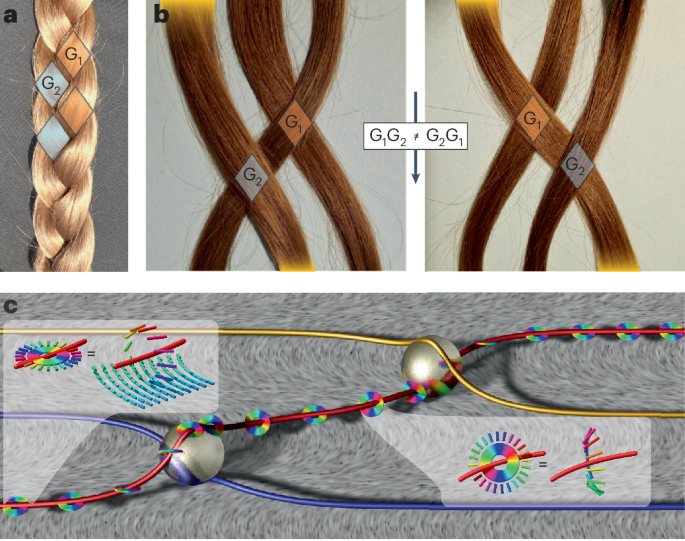
- Colloidal particles manipulated by light enable the creation of programmable crossings in nematic liquid crystals, facilitating non-Abelian braiding operations.
- This advancement allows for real-time observation and reordering of defect lines, which could have significant implications for quantum computing and information processing.
- The ability to compile these operations in real space marks a critical step toward practical applications of topological quantum computing.
The recent development in manipulating colloidal particles with light to weave defect lines in nematic liquid crystals represents a pivotal moment in the field of materials science and quantum computing. This innovation not only showcases the potential for programmable crossings but also highlights the intricate relationship between light and matter at the nanoscale. The ability to perform non-Abelian braiding operations in real time opens up new avenues for research and application, particularly in the realm of quantum information processing, where such operations are essential for error correction and logical gate implementation.
The technique involves steering colloidal particles using light to create and manipulate defect lines within the nematic liquid crystal matrix. These defect lines, which are topological in nature, can be arranged into specific configurations that allow for complex braiding operations. The significance of this lies in the non-Abelian statistics associated with these operations, which differ fundamentally from traditional Abelian statistics. This difference is crucial for the development of fault-tolerant quantum computers, as it enables the encoding of quantum information in a way that is inherently protected from local perturbations.
Moreover, the ability to observe and reorder these defect lines in real space adds a layer of practicality to the theoretical constructs of topological quantum computing. Researchers can now visualize the braiding processes, which not only aids in understanding the underlying physics but also facilitates the optimization of these operations for potential applications. The real-time manipulation of defect lines could lead to advancements in how quantum gates are constructed and utilized, potentially accelerating the timeline for practical quantum computing solutions.
This breakthrough also underscores the importance of interdisciplinary approaches in tackling complex challenges in quantum technology. By integrating concepts from optics, materials science, and quantum mechanics, researchers are paving the way for innovative solutions that could redefine computing paradigms. As the field progresses, the implications of this work extend beyond theoretical exploration; they could lead to tangible advancements in how we harness quantum phenomena for practical use, ultimately influencing a wide range of industries reliant on advanced computing capabilities.