Neurosymbolic planning using natural language communication for cooperative autonomous vehicles
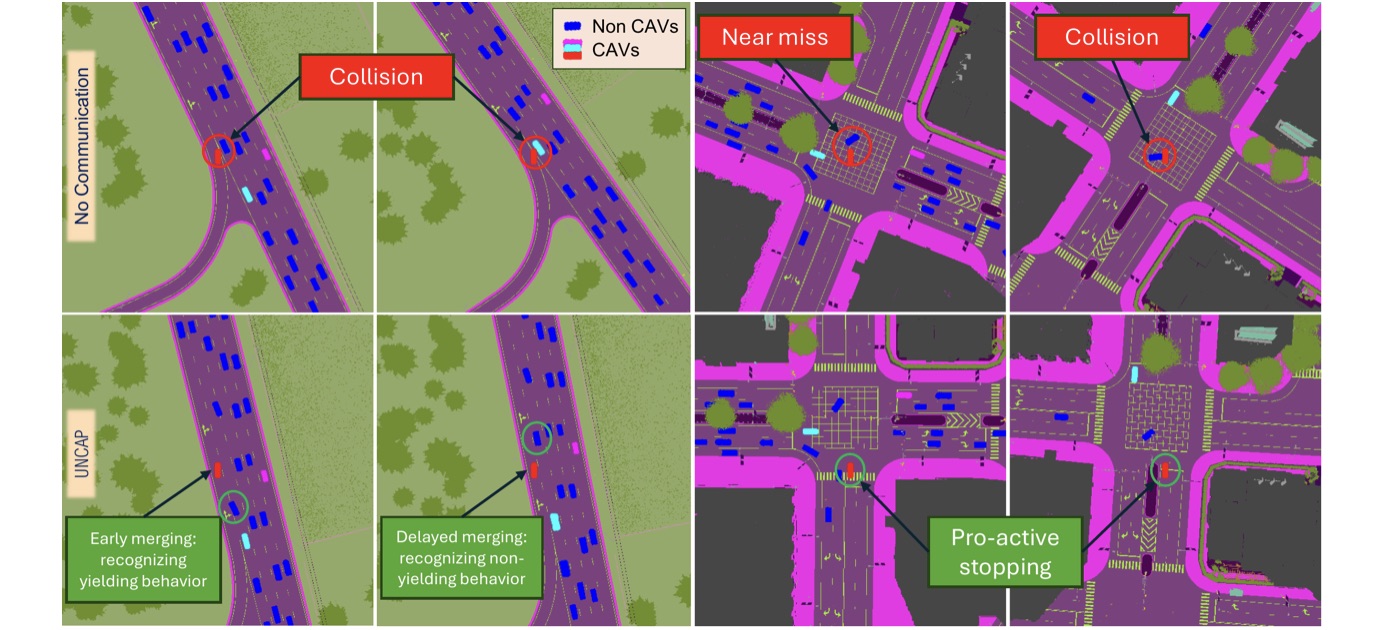
- UNCAP introduces a novel framework for cooperative autonomous driving that leverages natural language communication to enhance vehicle interactions.
- The framework significantly reduces communication bandwidth while improving decision-making efficiency and safety in complex driving scenarios.
- Despite its promising results in simulation, UNCAP's real-world applicability remains to be tested against challenges such as unreliable communication and environmental noise.
The development of UNCAP marks a pivotal moment in the evolution of cooperative autonomous vehicles, as it addresses the critical need for effective communication among vehicles in complex driving environments. The ability for vehicles to share observations in natural language rather than raw sensor data not only streamlines communication but also enhances the overall safety and efficiency of autonomous driving systems. This approach is particularly relevant now, as the deployment of autonomous vehicles on public roads increases, necessitating robust mechanisms for inter-vehicle communication to navigate challenging scenarios like intersections and occlusions.
UNCAP operates through a four-stage process that begins with vehicles broadcasting minimal information about their position and direction, allowing them to identify relevant neighbors. This selective communication is crucial; by filtering out irrelevant vehicles, UNCAP conserves bandwidth and computational resources, enabling it to scale effectively across diverse fleets. The framework then facilitates the exchange of observations, where vehicles articulate their surroundings using natural language, accompanied by calibrated confidence estimates. This innovative use of language not only simplifies the data shared but also allows vehicles to assess the reliability of the information received, thereby reducing decision uncertainty.
However, while UNCAP shows great promise, it is essential to acknowledge its limitations. Current evaluations are confined to simulated environments, which do not fully capture the complexities of real-world driving conditions, including the challenges posed by noisy sensors and unreliable wireless communication. Additionally, the reliance on existing vision-language models introduces latency in decision-making, as querying these models can take significant time. As the field progresses, addressing these limitations will be crucial for the successful implementation of UNCAP in real-world scenarios.
Looking ahead, UNCAP represents a significant step toward enabling autonomous vehicles to communicate and cooperate more like human drivers. The implications of this research extend beyond the realm of autonomous vehicles, highlighting the importance of efficient communication and trust-building among AI systems operating in teams. As the landscape of AI continues to evolve, the principles established by UNCAP may serve as a foundational framework for fostering collaboration among various autonomous agents, ultimately enhancing their collective capabilities in diverse applications.