Harnessing the structural synergy of high loading cobalt pyroborate on fibrous silica for efficient and recyclable advanced oxidation catalysis
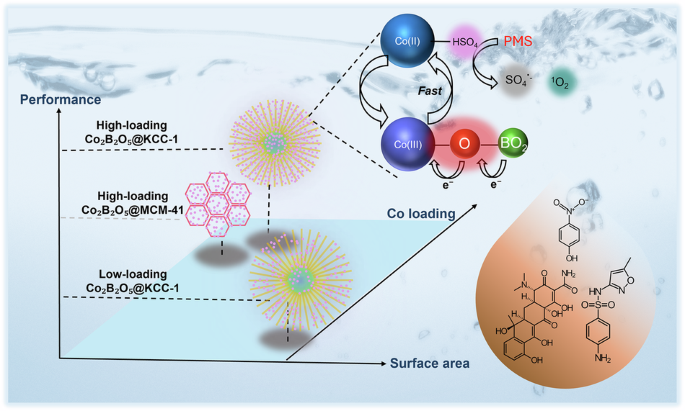
- The development of cobalt pyroborate catalysts supported on dendritic fibrous silica represents a significant advancement in addressing the degradation of persistent organic pollutants in wastewater.
- Optimizing the synthesis methods and molar ratios has led to a catalyst that not only demonstrates superior pollutant degradation but also exhibits high reusability and stability.
- Future research directions will likely focus on enhancing the catalyst's performance while minimizing cobalt leaching, which is crucial for practical applications in wastewater treatment.
The urgent need to address the release of organic pollutants, particularly pharmaceuticals, into water bodies underscores the significance of this research. Conventional wastewater treatment methods frequently fail to effectively degrade these contaminants, leading to environmental and health concerns. The introduction of cobalt pyroborate catalysts supported on dendritic fibrous silica (KCC-1) offers a promising solution through advanced oxidation processes (AOPs), which are designed to enhance the breakdown of such persistent pollutants.
The study meticulously details the synthesis of Co₂B₂O₅@KCC-1 catalysts using both one-pot hydrothermal and post-synthetic impregnation methods. By varying the Si/Co and B/Co molar ratios, the researchers optimized the phase composition and morphology of the catalysts. This optimization is critical, as it directly influences the catalysts' performance in degrading pollutants like 4-nitrophenol, tetracycline, and sulfamethoxazole. The resulting phase-pure Co₂B₂O₅ exhibits favorable redox properties, which are essential for effective pollutant degradation.
Notably, the optimized catalyst demonstrates not only superior degradation capabilities but also impressive reusability and stability, making it a viable candidate for practical wastewater treatment applications. The ability to maintain performance over multiple cycles is particularly important in industrial settings, where cost-effectiveness and sustainability are paramount. This characteristic positions the Co₂B₂O₅@KCC-1 catalyst as a potential game-changer in the field of environmental remediation.
Looking ahead, the study suggests that future research should aim to further enhance the catalyst's performance while addressing the issue of cobalt leaching. Reducing leaching is crucial for ensuring the environmental safety and economic viability of the catalyst in real-world applications. As the demand for effective wastewater treatment solutions continues to grow, the advancements presented in this study could pave the way for innovative approaches to managing organic pollutants in water systems.